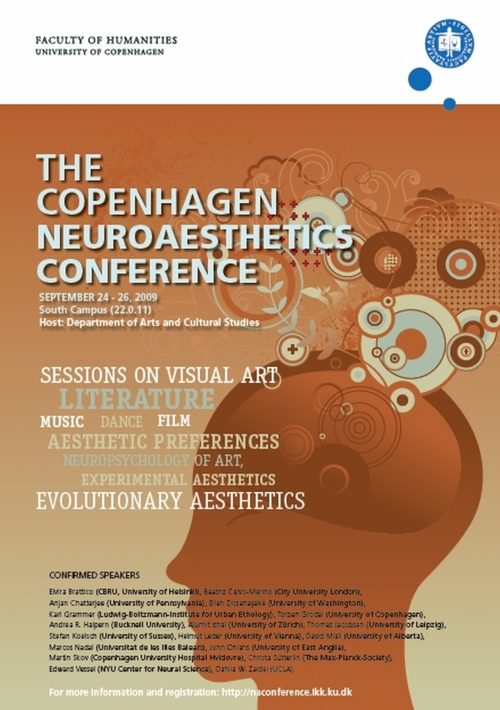
I am one of the organizers of a three day conference on neuroaesthetics that takes place at the University of Copenhagen from September 24 to September 26. If you are interested in the relation between art and the brain please consider joining us for what I believe will be an exiting event.
Neuroaesthetics is a fairly new field of inquiry. This conference is convened to discuss the state of the art of the field. It will bring together a number of leading researchers working on all aspects of neuroaesthetics. The conference will include sessions on Visual Art, Music, Literature, Dance and Film, Aesthetic Preferences, Neuropsychology of Art, Experimental Aesthetics, and Evolutionary Aesthetics, as well as one poster session. You can download the full program here.
Among themany great speakers who will speak at the conference I will only mention a few:Anjan Chatterjee (University of Pennsylvania), Ellen Dissanayake (University of Washington), Karl Grammer (Ludwig-Boltzmann-Institute for Urban Ethology), Torben Grodal (University of Copenhagen), Andrea R. Halpern (Bucknell University), Stefan Koelsch (University of Sussex), Helmut Leder (University of Vienna), David Miall (University of Alberta), Christa Sütterlin (The Max-Planck-Society), and Dahlia W. Zaidel (UCLA). There will be many more. Please take a look at the whole program at our conference website where you can also register for the event.
In March, the Center for Academic Research & Training in Anthropogeny hosted a conference on the “Evolutionary Origins of Art and Aesthetics”. The list of speakers was pretty impressive. Luckily, the lectures were taped and are now available on You Tube. Here is a video with lectures by Antonio Damasio on emotion, Helen Fisher on love, and Isabelle Peretz on music. I will probably post some of the other talks at a later point.
I am sure loads of you neuroscience buffs out there will be interested in hearing that a new book on neuroaesthetics has just been published. Edited by myself and Oshin Vartanian, it is published by Baywood. You can buy it directly from Baywood, or from retailers such as Amazon. To learn more about the book, read the introduction [pdf].
Research into the neurobiology of aesthetic behavior, one of the truly unique human traits, has undergone a revolution in the last ten years. In large part due to the possibility of imaging the human brain in various non-invasive ways it has become possible to investigate the neural mechanisms behind the perception of visual and auditive art, creative behavior, or aesthetic valuation of works of art. Quite a few psychologists and neuroscientists have heeded this call.The result is an ever-increasing number of research reports in peer-reviewed journals. Still, many of these results remain unknown, even overlooked. To take an example, when science writer Jonah Lehrer recently wrote a short article entitled “Unlocking the mysteries of the artistic mind” in Psychology Today, he restricted his discussion to a rehash of Semir Zeki [pdf] and V.S. Ramachandran’s [pdf] two famous papers published ten years ago in the Journal of Consciousness Studies. True, these two papers in many ways ignited the recent interest in neuroaesthetics, but much have happened in the decade since, and one of our ambitions in publishing this new book lies in the highlighting of this body of work.
Besides a lack of publicity, the field of neuroaesthetics is also marred by two other concerns. The first and most important is a lack of a coherent theory of what neuroaesthetics amounts to and, consequently, which kind of questions neuroaesthetics should be concerned with. This kind of methodological befuddlement is hardly unheard of in the early days of a new scientific field, but to make any headway naturally such questions need to be raised and debated. A central aim of the book is to further this debate. Secondly, research on the major art forms are too separated from each other. Scientists interested in visual art seem to know very little about the work going on in the labs of music researchers, and vice versa. To rectify this misère a little, and to insist that neuroaesthetics encompass all art forms, we have included chapters on visual art, music, literature, and film in the book. (If the book had been put together today, it would also had been possible to include chapters on dance and architecture as distinct forms of visual art.)
I shall not be the judge of whether or not the book accomplishes these goals. But I do hope that some of you will take the time to take a look at it.
We are currently running a survey on people’s attitudes towards neuromarketing and related topics. We hope that you will all take this survey, as well as shard this link to as many people as you like. We hope to get as many people’s opinion as possible, and report the results through appropriate channels (i.e. journal paper, Master’s paper, and online here)
The original text and link goes as follows:
NEUROMARKETING SURVEY
We would like to invite you to take part to this survey. Your answers will help to gather information about the perceptions and thoughts about the use of brain science methods in non-medical settings.
CONFIDENTIALITY
Any information that you provide will be confidential. All participants will be anonymous such that no personal information concerning you or your company will be made public either during, or after the completion and release of this study. The questionnaire should take about 10 minutes of your time. If you wish to receive a summary of the results (that you can pass on to your home company) please indicate at the end of this questionnaire and include your e-mail address. We will not use this e-mail for other purposes than for sending you the summary.
WHO IS BEHIND THIS STUDY
My name is Matteo Bellisario, and I am completing my final report for my Master Degree in Strategic Market Creation at the Copenhagen Business School, in Copenhagen, Denmark.
My academic supervisor for this research is Dr. Thomas Z. Ramsøy, head of the Decision Neuroscience Research Group at the Copenhagen Business School and Danish Research Centre for Magnetic Resonance at Copenhagen University Hospital.
The results will be part of my Master Thesis, and may, if suitable, be submitted to a peer-reviewed journal.
PLEASE CLICK ON THE LINK BELOW TO START THE SURVEY
I just love this title: Independence in ROI analysis: where is the voodoo? by Russel Poldrack and Jeanette Mumford. Lately, there has been much fuzz about so-called voodoo correlations in social neuroscience, and questions have been raised about the legitimacy of the claims put forward by Vul et al. (PDF of in press manuscript) and see criticism from Tania Singer and other colleagues here (PDF). Crucial to the criticism by Vul et al. is that the correlations between behavioural/social data and brain activation data show a correlation level that is highly improbable, or as Vul et al. put it:
Functional Magnetic Resonance Imaging studies of emotion, personality, and social cognition have drawn much attention in recent years, with high-profile studies frequently reporting extremely high (e.g., >.8) correlations between behavioral and self-report measures of personality or emotion and measures of brain activation. We show that these correlations often exceed what is statistically possible assuming the (evidently rather limited) reliability of both fMRI and personality/emotion measures. The implausibly high correlations are all the more puzzling because method sections rarely contain sufficient detail to ascertain how these correlations were obtained.
In the recent paper in SCAN, Poldrack and Mumford add to the criticism of Vul et al.:
We outline the problem of non-independence, and use a previously published dataset to examine the effects of non-independence. These analyses show that very strong correlations (exceeding 0.8) can occur even when the ROI is completely independent of the data being analyzed, suggesting that the claims of Vul et al. regarding the implausibility of these high correlations are incorrect.
I am not going to give you the details of the whole voodoo story here, since it has been covered nicely in the blogosphere. But what is interesting is that this discussion demonstrates just how easy it is to get pre-publication media and blogosphere coverage for researchers criticising brain research, much in the same vein as we saw in the case of criticism of neuroeconomics by Gul and Pesendorfer’s neo-conservative “A case agains mindless economics” (PDF), long before the article actually appeared… I guess in the end that as neuroscience and neuroimaging in particular becomes even more popular, it will always have the extremists of either side, saying either that it shows nothing/too much/fake information, or the wholesale version that lets people get away with anything, as long as they point to a brain…
I just love the way that YouTube is developing these days. If you just spend some time searching this wonderful site, you can get access to so many different teaching resources for psychology, neuroscience and philosophy that you could ever dream of. Seeing an interview with the younger Michael Gazzaniga speaking about the callosotomy procedure, BF Skinner speaking, even an item on Pavlov, just just blows my mind.
Below is just a few examples:
Gazzaniga on the split-brain procedure (good thing it’s not in colour)
And here is a thing on split-brain mind-blowing behaviour:
BF Skinner on operant conditioning
Or how about giving a demo of how patients with unilateral neglect actually behave (I’ve seen this many time when I was working clinically, but it’s like “what are you doing?”)
Here is a heads up for a recent study demonstrating – again – that the amygdala is not merely a “fear centre” in the brain. I have previously blogged about the amygdala, first not being a single structure, and that it is not only involved in fear.
In 2007, a team of French researchers demonstrated that direct stimulation of the amygdala did evoke emotional responses, but that there was a difference between which hemisphere was stimulated. Right amygdala stimulations induced aversive responses, in particular fear and sadness. In contrast, left hemisphere stimulation induced either positive (happiness) or negative emotions (fear, anxiety, sadness). As the abstract reads:
Very few studies in humans have quantified the effect obtained after direct electrical stimulation of the amygdala, in terms of both emotional and physiological responses. We tested patients with drug-resistant partial epilepsies who were explored with intracerebral electrodes in the setting of presurgical evaluation. We assessed the effects of direct electric stimulations in either the right or the left amygdala on verbally self-reported emotions (Izard scale) and on psychophysiological markers of emotions by recording skin conductance responses (SCRs) and by measuring the electromyographic responses of the corrugator supercilii (EMGc). According to responses on Izard scales, electrical stimulations of the right amygdala induced negative emotions, especially fear and sadness. In contrast, stimulations of the left amygdala were able to induce either pleasant (happiness) or unpleasant (fear, anxiety, sadness) emotions. Unpleasant states induced by electrical stimulations were accompanied by an increase in EMGc activity. In addition, when emotional changes were reported after electrical stimulation, SCR amplitude for the positively valenced emotions was larger than for the negative ones. These findings provide direct in vivo evidence that the human amygdala is involved in emotional experiences and strengthen the hypothesis of a functional asymmetry of the amygdala for valence and arousal processing.
Interestingly, there is more to say about this study. First, it may be that there is a systematic bias introduced by the way the researchers did the study. By using high-frequency (50 Hz) stimulation in 1 second, they might have induced one characteristic response of the amygdala. This structure is often seen as having quick “on-off” responses. Thus, one second pulse trains is actually a long duration for the amygdala. So a pulse of 20 milliseconds could be hypothesised to produce different responses. Also, the researchers found that GSR responses were actually larger for positive emotions, when they were reported. As the amygdala has often been implicated in unconscious emotional responses (mostly aversive responses) one may speculate that the left-hemisphere amygdala involvement in positive emotions may be related to conscious emotions.
As always, new findings leads to numerous novel questions, ideas and hypotheses. Which is why science is so much fun. But it is important to note the change we see today the role of the amygdala in emotional responses. We are moving away from the LeDouxian paradigmatic focus on fear (and some aversion)as the sole emotion of the brain, and more towards a balanced view towards a similar focus on positive emotions and (hopefully) more complex human emotions. Through this development, we can see that novel findings are breaking down the old ideas of neo-phrenology, breaking single structures into smaller parts, and into parts of a larger network of convergence and divergence structures. Keep your eyes open, more is on the way.
We highly recommend this interesting conference, and please note that the deadline for registration is tomorrow (!!!). So get this out to all and everybody, and see to that you register. Sounds like a good spot, too, for holding a conference
ESF-COST Conference
LAW AND NEUROSCIENCE: OUR GROWING UNDERSTANDING OF THE HUMAN BRAIN AND ITS IMPACT ON OUR LEGAL SYSTEM
In the past two decades, the field of Neuroscience has made significant progress in understanding the human brain. Many expect that this research will make further strides over the next decade. And many suggest that this knowledge could have a profound impact on the future of our legal system and legal practice. There has been much speculation over whether developments in neuroscience will overturn legal paradigms (e.g., by shattering the concept of free will). This conference will sidestep such speculations to address empirical evidence and current research on the likely impacts of neuroscience on legal practice, with a specific focus on European legal systems.
London School of Economics and Political ScienceDepartment of SociologyBIOS Centre for the Study of Bioscience, Biomedicine, Biotechnology and SocietyLondonUnited Kingdom
I just found this through mindhacks, and thought it was nice how well this illustrates the amazement one can get from witnessing neurological injury and disease. Through my early clinical practices, I’ve seen several kinds of unilateral neglect, blindsight, amnesias, aphasias, weird dementias (Wernicke-Korsakoff, fronto-polar, Parkinson Plus), and youtube may be the place to find good illustrations of this to the general public.